Ice Water Cooling
Efficient Temperature Control with Ice Water Systems
Introduction: The Role of Ice Water in Industrial and Building Cooling
In both industrial food and beverage processes and building air conditioning, ice water cooling systems offer reliable, efficient, and precise cooling. Especially where consistent low temperatures and hygiene are essential – such as in food production or pharmaceutical environments – chilled water systems provide an ideal balance between performance and energy use. With operating temperatures close to 0 °C, they enable optimal process cooling with minimal environmental impact.
What Is Ice Water Cooling? Definition and Function
Chilled water refers to water cooled to between 0.5 °C and 1°C using evaporator-based systems such as falling film chillers or pillow plate evaporators. The chilled water circulates in a closed or open loop, absorbing heat from products or environments via heat exchangers and returning to the cooling unit for re-cooling.
This indirect cooling method minimizes refrigerant volume and allows precise process control.
Ice water cooling systems offer reliable, efficient, and precise cooling.
Benefits and Key Features of Chilled Water Cooling
- Extremely low temperatures without freezing risks
- High energy efficiency due to direct contact heat transfer
- Consistent and uniform cooling
- Hygienic and easy to clean, ideal for food applications
- Low refrigerant demand in indirect systems
- Integrates with ice storage or heat recovery systems
- Simplified control and automation compatibility
Chilled Water Cooling enables high energy efficiency due to direct contact heat transfer.
Refrigerants and System Types
Depending on process requirements, various refrigerants are used:
- Ammonia (NH₃) and CO₂ for natural, sustainable cooling
- HFCs for compact systems where space is limited
- Glycol-water blends for freeze-protected loops
Operation modes include pumped systems, gravity-fed setups, or direct expansion designs.
Operation modes include pumped systems, gravity-fed setups, or direct expansion designs. Increasingly aswell being operated with propylene and ethylene glycol-water mixtures in various concentrations.
System Designs: Open vs Closed Chilled Water Loops
- Open systems involve direct water exposure and are easy to clean (ideal for food).
- Closed systems protect against contamination and suit technical cooling applications.
Each has specific advantages depending on hygiene, maintenance, and integration needs.
Each system has specific advantages depending on hygiene, maintenance, and integration needs.
Engineering and Planning Services
Our experts design custom cooling systems tailored to your specific load profiles and temperature needs:
- Load calculation and system sizing
- COP optimization for energy savings
- Evaporator selection and flow dynamics
- Integration into process or facility systems
- Cost-efficiency through TCO-based design
Our cooling methods allow precise process control.
Technical Summary Ice Water Cooling
| Feature | Specification |
| Temperature Range | 0.5 °C to 1°C |
| Refrigerants | NH₃, CO₂, HFCs, Glycol-water mixtures |
| Evaporators | Falling film, Pillow Plate evaporators |
| System Types | Open or closed water loops |
| Applications | Food, beverage, pharma, HVAC |
| Control Options | Temperature or COP-based |
| Hygiene Level | CIP-compliant, stainless steel, polishable |
| Efficiency | High performance, low energy input |
Maximum efficiency due to high performance and low energy input.
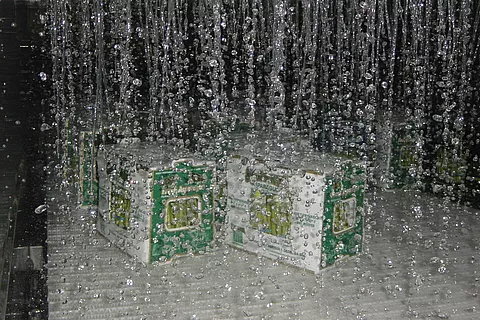
Ice water heat transfer
Ice water with temperatures of 0.5°C can perform very well for direct product cooling of large quantities of produce in a very short time.

Plate ice heat transfer
Plate Ice or Chip Ice with temperatures of -0.5°C can perform very well for direct product cooling of large quantities of produce in a very short time.
We have always assimilated engineering science and thermodynamics optimally in the various manufacturing processes.
Thermodynamicists,mechanical engineers and welding engineers define the dimensioning, design and construction of customised heat exchanger panels and systems in materials ranging from mild and austenitic steels through to titanium, and ensure successful distribution of their work worldwide.
In doing so they fall back on production engineering expertise and calculations developed in the course of the past hundred years that are still being continuously optimised in an ongoing process.
In the perception of our customers, the Buco product stands for:
Technical and process-oriented consulting
Thermodynamic efficiency
Quality and longevity


