Heat Recovery from Laundry Wastewater
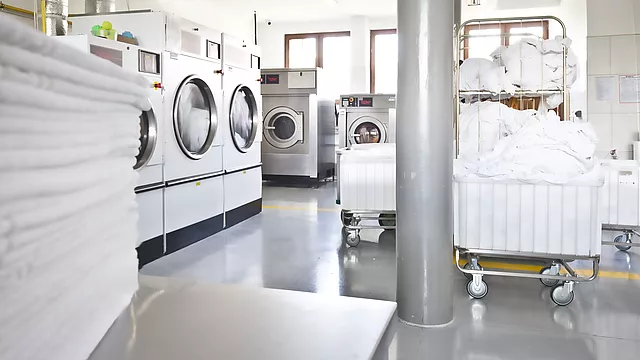
Efficient heat recovery systems for industrial laundries significantly cut energy consumption and operational costs. The BUCO falling film chiller, equipped with stainless steel pillow plate heat exchangers, offers a reliable, hygienic, and highly efficient solution for preheating process water using wastewater heat.

Robert Streif
General Manager
Robert is the managing director of Heat Transfer Technology GmbH in Olching. For the past 27 years, he has specialised in the use of pillow plate heat exchangers in industrial applications.
What Are Pillow Plate Heat Exchangers?
Pillow plate heat exchangers consist of two thin stainless steel sheets, laser-welded and inflated to form optimized flow channels for heat transfer. In laundry operations, warm wastewater transfers its heat to cold freshwater through these plates – preheating it efficiently for reuse.
This technology is ideal for contaminated wastewater, as the smooth stainless-steel surface prevents fouling and allows in-place cleaning during operation, ensuring consistent performance and hygiene.
Initial Situation in Industrial Laundries
Commercial laundries consume vast amounts of hot water each day, producing an equal volume of warm, contaminated wastewater after each washing cycle.
Traditionally, this energy-rich wastewater is discharged into the sewer system, while new water is heated using fossil fuels such as natural gas or heating oil – a costly and inefficient process that wastes valuable thermal energy.
Conventional Approach Before Heat Recovery
Before implementing heat recovery systems, most industrial laundries released their warm wastewater directly into the sewage system, losing up to 50% of recoverable heat energy.
This resulted in higher fuel consumption, increased CO₂ emissions, and unnecessary operating expenses.
Pillow plate heat exchangers optimize flow channels for heat transfer.
Why Choose the BUCO Falling Film Chiller?
The BUCO falling film chiller is engineered specifically for heat recovery from contaminated laundry wastewater. It enables efficient energy transfer by feeding cold freshwater (10–15 °C) into the unit, which is preheated to 20–45 °C using wastewater at 25–50 °C, depending on the configuration and plant conditions.
Key Advantages
- Custom-built design for any available space and process requirements
- Open, accessible system layout for easy cleaning and robust operation
- High efficiency even under fluctuating flow and temperature conditions
- Long service life with minimal maintenance needs
The BUCO falling film chiller provides high efficiency even under fluctuating flow and temperature conditions.
Main Technical Benefits
The BUCO falling film chiller delivers maximum heat recovery performance and operational reliability through the following features:
- High heat transfer coefficients up to 2000 W/m²K
- 100% stainless steel construction – resistant to contamination and saltwater
- Cleanable during operation, enabling continuous production
- No seals or gaskets, reducing maintenance requirements
- Low fouling risk and easy inspection access
- Safe during ice formation, ensuring operational safety
- Low control complexity with high system stability
- Short payback period due to high energy savings
Economic and Environmental Benefits
Integrating a BUCO heat recovery system can reduce fuel or heating oil consumption by up to 50%, delivering immediate savings and long-term sustainability.
By utilizing wastewater heat, laundries can:
- Cut energy costs dramatically
- Lower CO₂ emissions and improve environmental performance
- Enhance process efficiency and resource utilization
- Achieve fast amortization and long-term ROI
Typical Areas of Application
BUCO pillow plate heat exchangers are ideal for:
- Hotel and commercial laundries
- Textile cleaning plants
- Industrial washing systems
- Process water preheating in food, beverage, and chemical industries
These systems can be seamlessly integrated into existing water treatment or heating processes, maximizing energy efficiency across diverse industrial sectors.
Integrating a BUCO heat recovery system can reduce fuel or heating oil consumption by up to 50%.
Technical Overview
| Parameter | Specification |
| Media | Laundry wastewater and freshwater |
| Heat Transfer Coefficient | Up to 2000 W/m²K |
| Construction Material | 100% stainless steel |
| Operating Temperature Range | 10 °C – 50 °C |
| Cleaning | Possible during operation |
| Efficiency Gain | Up to 50 % reduction in heating energy |
| Applications | Industrial laundries, textile cleaning, hotel laundries |
Summary for Engineers and Decision-Makers
The BUCO falling film chiller with pillow plate heat exchangers provides a robust, low-maintenance, and high-efficiency solution for recovering heat from laundry wastewater.
Fully built from stainless steel, it ensures durability, hygiene, and optimal thermal performance.
With up to 50 % fuel savings, simple integration, and a rapid return on investment, BUCO technology represents an ideal choice for sustainable energy management in industrial laundries.
The BUCO falling film chiller ensures durability, hygiene, and optimal thermal performance.
Frequently asked questions
Heat Recovery from Laundry Wastewater
Laundry wastewater heat recovery refers to capturing the thermal energy in the warm, contaminated effluent produced during washing and using that energy to pre-heat fresh or process water before it enters the heating system. This reduces the fuel (gas, oil, steam) required for heating fresh water.
In an industrial laundry context, this means the wastewater from washing machines or tunnels (typically ~25-50 °C) transfers heat via a specialised heat exchanger to cold incoming water (~10-15 °C), boosting the fresh-water temperature significantly before it enters the boiler or heater
Because industrial laundries frequently consume very large volumes of hot water and produce equally large volumes of warm wastewater, which often goes unused. By recovering that ‘waste’ heat you:
- Lower fuel consumption for water-heating (often by up to 50%).
- Reduce operating costs.
- Improve sustainability, reduce CO₂ emissions and enhance your facility’s energy-profile.
- Potentially shorten payback time thanks to the large loads and continuous operation typical in B2B laundry operations.
Typical suitable technologies include:
- Pillow-plate or “falling film” stainless steel exchangers – good for contaminated or high-fouling streams due to open design and high cleanability.
- Shell-and-tube and disc heat exchangers – used in situations where the wastewater is moderately clean or for secondary recovery.
- Water-to-water counter-flow exchangers are generally more efficient than parallel-flow in this context.
Selection depends on contamination level, maintenance capacity, temperature differentials and space constraints.
Important parameters include:
- Wastewater temperature and flow rate, and incoming freshwater temperature. These determine the thermal potential.
- Heat transfer coefficient (e.g., values up to ~2000 W/m²K reported in specialist pillow-plate systems) and surface area.
- Construction material and fouling/cleaning design: For high-soiling laundries, stainless steel and accessible open surfaces help.
- The minimum flow or design case (worst-case loads) to ensure system robustness.
- Integration into existing water-/heat-systems: how the pre-heated water will be used, return-temperatures, piping, controls, space.
- Maintenance requirements: how easily can the exchanger be cleaned or flushed during operation.
Case studies and industry sources indicate:
- Up to ~50% reduction in heating energy (fuel or electricity) for water-heating in laundry operations.
- Additional benefits: improved drying efficiency because incoming linen is warmer, thus less residual moisture in dryers (leading to further energy reduction) in some cases up to ~20% extra.
- Significant CO₂ and emissions reductions as less fossil fuel is burned for heating.
Remember: actual performance depends on site-specific factors (temperatures, flows, fouling, integration).
While payback depends heavily on site-specifics, many industrial laundries report paybacks in the few-year range – often 2–5 years. Higher fuel costs, steady large loads and minimal downtime favour shorter paybacks.
Key influencing factors: capital cost (equipment + installation + integration), fuel cost and escalation, availability of waste-heat (flow/temperature), maintenance costs, and operational reliability.
Anticipated challenges include:
- Fouling: Laundry wastewater often contains lint, detergents, oils, fine solids — these can reduce heat transfer. Design must minimise fouling and simplify cleaning.
- Variable loads: Fluctuations in wastewater flow or temperature (e.g., shift operations) affect efficiency. The system must be designed for worst-case and average loads.
- Access and cleaning: Equipment must be accessible for inspection and cleaning without production disruption.
- Integration risk: If recovered heat cannot be effectively absorbed or used downstream, energy is wasted.
- Material durability: Corrosion or erosion in aggressive laundry effluent may shorten equipment life if materials are not selected properly.
Yes – many systems are designed to integrate into existing facilities. Key considerations:
- Sufficient space for the exchanger and piping. Some models are compact or ceiling-mounted to suit limited space.
- Existing water- and heat-systems must be evaluated to accept the pre-heated water (e.g., piping, valves, buffer tanks).
- The wastewater path and freshwater feed must be accessible and ideally have consistent flow and temperature.
- The cost-benefit must be reviewed carefully: sometimes small laundries with low throughput may not justify the investment.
Yes. These include:
- Legislation: In some countries, wastewater heat recovery is defined as a form of renewable energy – this can affect incentives or compliance.
- Sewage/Wastewater treatment: Lowering the temperature of wastewater too much may impact downstream biological treatment or regulatory discharge limits.
- Hygiene: Since laundry wastewater can be contaminated, the exchanger must maintain hygienic separation of streams if process water is reused downstream.
- Permitting and operator approvals: In some jurisdictions extracting heat from sewers or industrial effluent may require permits or consent from utilities.
A rough estimation involves:
- Measuring or estimating the volume flow of wastewater (m³/h or L/s) and its average temperature (°C).
- Measuring the fresh-water flow and its inlet temperature.
- Calculating the temperature rise achievable on the fresh water side considering exchanger performance and temperature differential.
- Using the specific heat formula: to estimate thermal energy (e.g., in kW or kWh).
- Taking into account system losses, fouling, intermittent operation, cleaning downtime.
- From this you can estimate the fuel or energy offset potential and translate to ROI. Literature shows substantial potential: e.g., when wastewater is at ~40-50 °C and freshwater at ~10-15 °C, substantial gains are possible.
For a fully reliable business case, a detailed site audit is strongly recommended.
Typical operating ranges in laundry applications:
- Wastewater inlet: ~25-50 °C depending on washing cycle, machine type, pre-rinse stages.
- Freshwater/Feed water input: often ~10-15 °C, depending on mains water temperature and season.
- Pre-heated water outlet: Systems may raise fresh water to ~20-45 °C before it enters the primary heating process.
Designers should consider lowest temperatures (worst-case winter) and highest loads (peak shift) when sizing.
Fouling (deposits, lint, oils, detergents) reduces heat-transfer coefficients, increases pressure drop and lowers efficiency. Industry sources show fouling may reduce performance by several K of temperature lift if unmanaged.
Mitigation strategies:
- Use an exchanger design with larger flow cross-section, accessible surfaces or open channel (especially pillow-plate type) to allow cleaning during operation.
- Incorporate periodic cleaning, back-flushing, filter screens, lint traps upstream of exchanger.
- Oversize the exchanger surface area to compensate for fouling buildup over time.
- Monitor performance (∆T, pressure drop, flows) and schedule maintenance proactively.
Good practice includes:
- Regular inspection of fouling/deposits and cleaning intervals.
- Monitoring of key parameters: inlet/outlet temperatures, flow rates, pressure drops, heat transfer performance (∆T and load).
- Recording and tracking energy savings vs. baseline to verify ROI.
- Checking for corrosion, mechanical fatigue, seal/gasket integrity (if any).
- Ensuring the control system handles variable loads and protects against freezing, high pressure or high contamination events.
- Ensuring operator training, spare parts availability and maintenance log-keeping.
Several models are common:
- Direct capital investment by the laundry operator, with savings accruing fully to the operator.
- Energy-service-contracts (ESCO) or contracting models where a third-party installs and operates the system, and the facility pays for delivered heat or a share of savings.
- Availability of subsidies, grants or incentive programmes for energy efficiency or waste-heat recovery, depending on country/region.
- Pay-for-performance models where payments are tied to verified energy savings.
Selecting the right model depends on budget, risk appetite, existing infrastructure and strategic energy-goals.
When selecting a supplier or partner, look for:
- Proven track record of installations in laundry or similarly contaminated wastewater applications.
- Materials expertise (e.g., stainless steel, corrosion resistance) and cleaning/access design.
- Ability to provide robust engineering, detailed sizing, hydraulic/thermal modelling, and clear ROI calculations.
- Service, maintenance support, performance guarantees and spare-parts strategy.
- Flexibility in design (custom space constraints, modular solutions) and integration capability into existing systems.
Questions to ask:
- What is the expected heat-recovery efficiency and real-life case performance?
- How is the system cleaned and maintained? What downtime is required?
- What is the payback time and what assumptions underpin it?
- How will integration with freshwater feed and heating system work?
- What happens if loads or flows change in future? Is the system scalable?
- Can you provide references from similar laundry installations?
A strong partner adds technical clarity, risk-mitigation and ensures the investment delivers real value.
We have always assimilated engineering science and thermodynamics optimally in the various manufacturing processes.
Thermodynamicists,mechanical engineers and welding engineers define the dimensioning, design and construction of customised heat exchanger panels and systems in materials ranging from mild and austenitic steels through to titanium, and ensure successful distribution of their work worldwide.
In doing so they fall back on production engineering expertise and calculations developed in the course of the past hundred years that are still being continuously optimised in an ongoing process.
In the perception of our customers, the Buco product stands for:
Technical and process-oriented consulting
Thermodynamic efficiency
Quality and longevity


