Ice Bank
Efficient Energy Storage and Cooling for Industry and Commerce
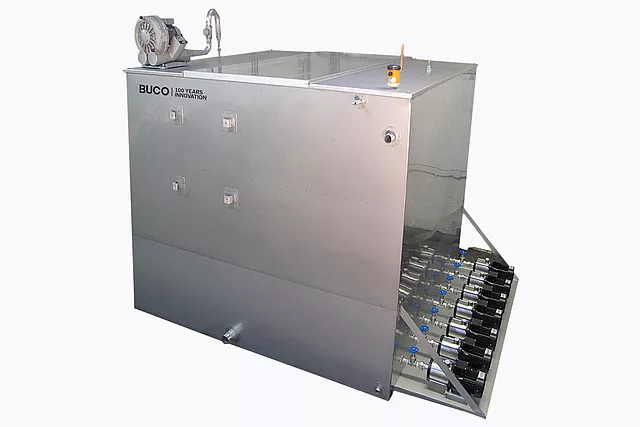
Do you want to know more about Ice Banks?
Product Leaflet BUCO Industrial Ice bankMaximum Cooling Performance with Low Energy Input
An ice bank storage system is a thermal energy storage device that causes water to freeze in a controlled manner. The energy stored during the phase change is later used to provide large amounts of cooling in a compact space. This enables peak load management, reduces operating costs, and allows for more efficient design of refrigeration systems.
Your Benefits at a Glance
- Fast and reliable cooling thanks to constant ice water temperatures from 0.5°C
- Reduction of peak loads and lower electricity costs due to night-time electricity use
- Compact, hygienic construction (stainless steel, easy cleaning)
- Flexible retrofitting into existing cooling systems
Request a free consultation now and learn how to reduce your energy costs by up to 30%.
An ice bank storage system allows for more efficient design of refrigeration systems.
What are the advantages with ice banks?
- very stable ice water temperature below 1°C up to the end of the process
- very high cooling power for peaks
- low refrigerant content
- safe oil return
- stainless steel completely
- open design, easy inspection, easy cleaning
- use of existing tanks possible

Visualization for understanding the working principle of an ice bank
What is an Ice Bank Storage System?
An ice bank storage system is a thermal energy storage solution that deliberately freezes water and stores the resultant latent heat energy. This energy is released as required by targeted thawing and is used as cooling energy in the form of ice water (approx. 0.5 °C). This allows peak load buffering, reduced energy costs, and improved efficiency for chillers and heat pumps.
An ice bank storage system allows peak load buffering and reduced energy costs.
Operating Principle of the Ice Bank Storage System
The heart of the ice storage system is an evaporator unit installed inside a water tank. During charging, a connected chiller system removes heat from the water, causing ice to form evenly on the evaporator plates. In the cooling operation, this ice is melted in a controlled way by warm return or process water. This results in a constant ice water temperature, even under highly variable demand.
Phases of Energy Conversion
- Freezing (Charging Phase): The chiller extracts heat; ice forms on the plates.
- Cooling Operation (Discharge Phase): Return water thaws the ice, generating ice water at approx. 0.5°C.
- Storage efficiency: Up to 84.9 kWh/m³ storage capacity by utilizing the enthalpy of fusion of water.
During the cooling operation, this ice is melted evenly in a controlled way by warm return or process water.
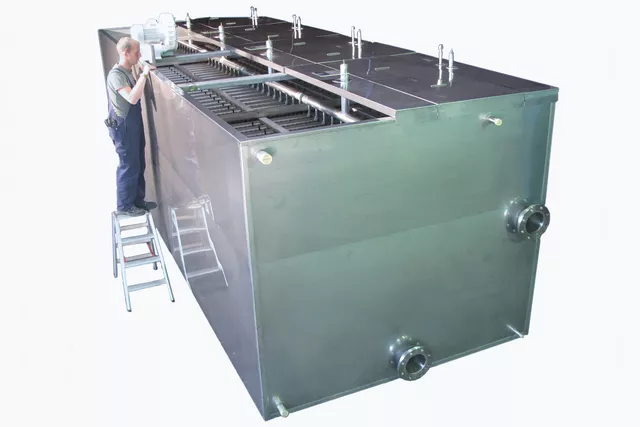

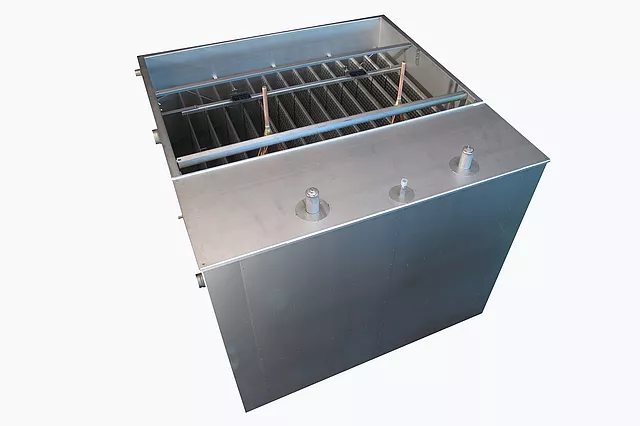
Economic Efficiency and Advantages of Ice Bank Storage
The use of ice storage systems offers both economic and technical advantages to companies.
Reduction in Operating Costs
- Utilization of low-cost night-time electricity rates for charging
- Avoiding expensive peak loads
- Improved coefficient of performance (COP) for chillers through lower nighttime outdoor temperatures
Reduced Investments
- Smaller chillers are sufficient, as the ice bank storage buffers the peak loads
- Avoiding unnecessary oversizing of chillers
- Retrofitting into existing systems is possible
Operational Advantages
- Constantly low water temperatures until the end of the thaw cycle
- Short reaction time for sudden increased demand
- Hygienic and maintenance-friendly: Stainless steel components, open design, easy cleaning
Ice Bank Storage Systems Combined with Heat Pumps
Connecting an ice bank storage system with a heat pump greatly expands its applications:
- In heating mode: The heat pump uses the ice bank storage as an efficient heat source
- In cooling mode: The ice bank storage serves as a buffer tank for process or room cooling
- In combination with solar thermal or renewable energies: Seasonal energy storage becomes possible
By means of this hybrid solution, energy savings of up to 50% can be achieved in industry and commerce.
Energy savings of up to 50% can be achieved in industry and commerce.
Fields of Application for Ice Bank Storage Systems
Ice Bank storage systems are used in various industries where reliable cooling or combined heating and cooling technologies are required:
- Dairy and food industry (e.g. milk and brewing water cooling)
- Beverage industry
- Air conditioning for office and commercial buildings
- Process cooling in the chemical and pharmaceutical industries
- Energy management in combination with renewable energy sources
Combination with Solar Energy
Integrating solar thermal systems with an ice storage system allows for:
- Seasonal energy buffering for heating and cooling purposes
- Utilization of the high efficiency of solar thermal collectors (up to 80% efficiency)
- Wider application in buildings where ground probes or groundwater are not available
This creates a regenerative energy system that covers both heating and cooling needs.
Ice bank storage systems create a regenerative energy system that covers both heating and cooling needs.
Technical Overview – Ice Storage
For engineers and planners, the overview below provides the most important technical data and properties at a glance:
- Storage size: 50 – 2000 kWh cooling energy
- Ice water temperature: constant at approx. 0.5°C
- Storage density: up to 84.9 kWh/m³ at ΔT = 6 K
- Latent heat of water: 333 kJ/kg
- Material: Stainless steel for durable, hygienic operation
- Construction types / dimensions:
- Compact system: 0.5 × 2.3 × 1.5 m
- Type A: 2.5 × 2.3 × 2.2 m
- Type B: up to 10 × 2.3 × 2.2 m
- Refrigerant: Suitable for all common fluids and operating modes, including brine operation
- Integration: As a stand-alone unit or into existing cooling systems
Conclusion – Ice Bank Storage
An ice bank storage system is an energy-efficient, economical, and sustainable solution for cooling and heating in industry and commerce. It lowers operating costs, reduces peak loads and offers maximum operational reliability – especially when combined with heat pumps, solar energy, and low-cost electricity tariffs.
An ice bank storage system is an energy-efficient, economical, and sustainable solution.
Frequently asked questions
By using a falling film chiller as a precooler, the required amount of ice is reduced, resulting in lower water temperatures entering the ice storage tank. Water is first supplied into the lower tank, initially into a mixing tube, then circulated by a pump to the trickle film cooler at a constant flow rate. To ensure the highest quality for food and dairy products, cooling performance must not drop during peak demand.
A sensor located between the heat exchanger plates allows the desired ice thickness to be set. The sensor sends a signal to an ice thickness controller, which provides the on/off signal to the chiller for operation. If the ice storage is already delivered with an installed chiller from us, the ice thickness sensor has already been tested. However, after long-term operation, conditions may arise that could not be simulated during the trial run. Therefore, the ice thickness may need to be readjusted.
Solar thermal collectors offer much higher efficiency with up to 80%. In comparison, photovoltaic modules have an efficiency of only between 14 and 22%. Therefore, with a solar thermal system, much less installation area is needed, providing a clear advantage compared to photovoltaics. The use of an ice storage system in combination with solar energy enables seasonal intermediate storage of energy for the use of heat pumps. When ground probes are not permitted, ground is unavailable, groundwater cannot be used, or an air-water heat pump is excluded, ice storage is a good option. Additionally, active room cooling in summer can be an attractive argument, especially given rising summer temperatures. This may also represent a reasonable alternative in residential dwellings. The ice storage system is fed by solar energy and ambient heat, which is derived from the air around the solar collectors, natural ground heat, and possibly other sources such as wastewater heat recovery. Furthermore, the considerable crystallization energy of 93 kWh/m³ released during the phase change from water to ice can be made use of.
Solar collectors or absorbers are used as the main heat source and for the regeneration of the ice storage system. These collectors enable highly efficient and effective operating temperatures. By using unglazed collectors or active ventilation, ambient air heat can also be used. Condensation on the collector surface makes a significant contribution to the heat gain. When glazed and/or selective collectors are used, the solar heat can also be used at higher temperatures directly for space heating and/or domestic hot water.
Ice storage systems are increasingly popular as an alternative solution for storing seasonal heat in various residential and commercial buildings. In view of lower heating demand and increasing cooling needs with renewable energy, ice storage technology in combination with solar energy is becoming increasingly important.
We have always assimilated engineering science and thermodynamics optimally in the various manufacturing processes.
Thermodynamicists,mechanical engineers and welding engineers define the dimensioning, design and construction of customised heat exchanger panels and systems in materials ranging from mild and austenitic steels through to titanium, and ensure successful distribution of their work worldwide.
In doing so they fall back on production engineering expertise and calculations developed in the course of the past hundred years that are still being continuously optimised in an ongoing process.
In the perception of our customers, the Buco product stands for:
Technical and process-oriented consulting
Thermodynamic efficiency
Quality and longevity


