Falling Film Chiller
High-Efficiency Cooling with Falling Film Technology
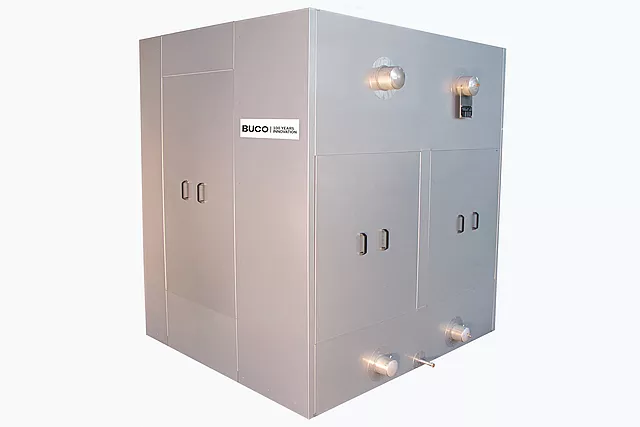
Do you want to know more about Falling Film Chillers?
Product Leaflet BUCO Falling Film ChillerIntroduction: Technology Overview of the Falling Film Chiller
In industrial process engineering, precise, energy-efficient, and hygienic cooling is essential – especially for sensitive applications in the food, pharmaceutical, and chemical industries. The falling film chiller (also known as a Baudelot cooler or falling film cooler) offers a proven solution for producing chilled water close to the freezing point. This open, low-maintenance cooling technology utilizes the high heat transfer performance of thin water films flowing over stainless steel surfaces.
What Is a Falling Film Chiller?
Definition, Construction, and Operation
A falling film chiller consists of vertically arranged, pillow-shaped stainless steel plates – so-called pillow plates. Water flows down these plates as a thin film and is cooled by the refrigerant (e.g., ammonia, Freon, glycol, or CO₂) passing underneath. The evaporation or passage of the refrigerant inside the plates ensures intensive heat extraction. The chilled water achieves temperatures as low as 0.5°C, making it ideal for industrial processes that require low media temperatures.
The construction typically includes:
- A distribution tray for even water supply
- Open, welded stainless steel plates with high cleanability
- A closed cooling circuit with compressor, condenser, expansion valve, and heat exchanger
The falling film chiller offers a proven solution for producing chilled water close to the freezing point.
What are the advantages with Falling Film Chillers?
- No risk of freezing with ice water of 0.5 °C and destruction of the aparatus
- Water chiller with low cost per kWh, high efficiency & low pressure drop
- High heat transfer coefficients
- Simplicity of control
- Fully welded, no spare parts such as seals in this industrial water cooling chiller
- Easy access to the open system water film chiller and easy to clean even during operation
- Suitable chiller for contaminated liquids (for example greywater or red water)
- Low tendency to fouling
- Water film chiller completely made of stainless steel, also for salt water

Visualization for understanding the working principle of a falling-film chiller
Advantages and Special Features: Energy Efficiency, Cleaning, Operational Safety
Falling film chillers offer numerous advantages over conventional cooling methods:
- Minimal risk of freezing at 0.5°C, as there is an open water side
- High energy efficiency due to direct heat transfer
- Low maintenance - no seals, no moving parts
- Easy cleaning, even during operation
- Low susceptibility to contamination
- Robustness against control fluctuations, no mechanical damage in case of ice formation
- Cost-effective operation with natural refrigerants such as ammonia (NH₃) or CO₂
Falling film chillers offer high energy efficiency due to direct heat transfer.
Comparison to Plate Heat Exchangers: Performance Data, Costs, Maintenance
Unlike closed plate heat exchangers, falling film chillers provide an open system without seals. This eliminates typical weak points such as blockages, seal wear, or time-consuming and costly disassembly for cleaning.
At a Glance Comparison:
| Criterion | Falling Film Chiller | Plate Heat Exchanger |
| Risk of ice formation | Very low | High (below 1°C) |
| Cleaning | Open & possible during operation | Only when stopped & disassembled |
| Maintenance costs | Minimal | High (seals, & control systems) |
| Footprint | Compact | Depends on piping system |
| Control costs | Simple | High (sensors, controllers needed) |
Falling film chillers provide an open system without seals.
Typical Application Areas: Food, Pharma, Energy, Environment
Falling film chillers are ideal for processes where hygienic conditions and high cooling performance are required:
- Food industry: dough cooling, dairy products, fruit, vegetables, fish, seafood
- Pharmaceutical and biotechnology: temperature stabilization for fermenters and reactors
- Heat recovery: e.g., from wash water
- Energy-efficient building and process cooling
- Ice water storage systems as an alternative to conventional cold storage
In industrial process engineering, precise, energy-efficient, and hygienic cooling is essential.
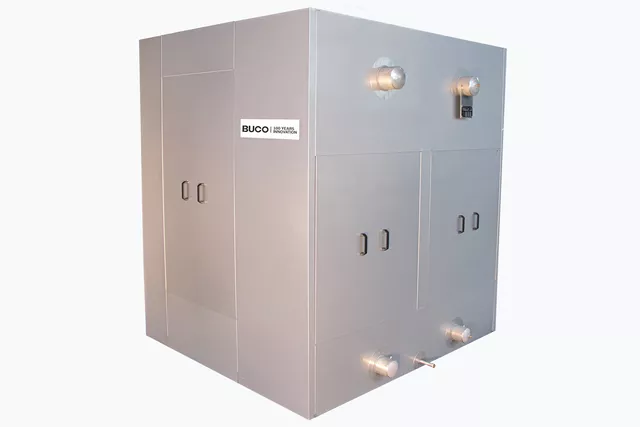
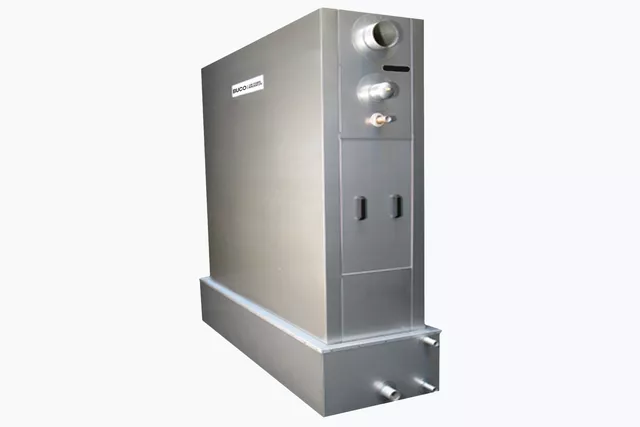
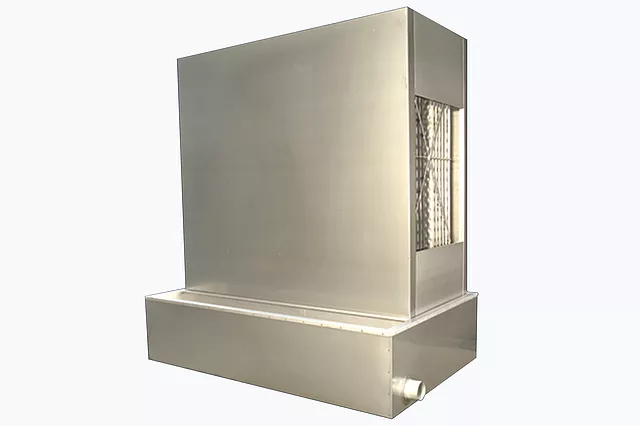
Manufacturing, Materials, and Refrigerants: Stainless Steel, Ammonia, CO₂
Falling film chillers are made from high-quality stainless steel, fully welded, and without seals – ideal for processes with stringent hygiene requirements. Preferred refrigerants are ammonia (NH₃) or CO₂. Both are environmentally friendly, ozone-neutral, and highly efficient. Brine or glycol systems can also be integrated for special requirements.
Falling film chillers work well for processes with stringent hygiene requirements.
Integration in Industrial Cooling Systems: Construction, Control, Optimization
A falling film chiller can be modularly integrated into new or existing systems. Control is usually via simple valve technology, making complex control systems as found in plate heat exchangers unnecessary. Optionally, oil separation can be provided for NH₃ or CO₂ systems. Combining with buffer tanks or ice water storage tanks adds flexibility for peak loads.
Combining with buffer tanks or ice water storage tanks adds flexibility for peak loads.
Technical Overview
| Feature | Description |
| Water outlet temperature | Down to 0.5°C |
| Construction | Open, fully welded, no seals |
| Materials | Stainless steel (1.4301 / 1.4404 up to titanium), polishable |
| Refrigerants | NH₃, freon, CO₂, glycol, brine |
| Typical capacities | 50 kW to >10.000 kW |
| Applications | Food, biotechnology, energy, ice water storage |
| Maintenance | Minimal, no downtime needed for cleaning |
| Control | Simple valve control, no sensitive sensors or controllers |
This technology utilizes the high heat transfer performance of thin water films flowing over stainless steel surfaces.
Frequently asked questions
A falling film chiller, also known as a baudelot chiller, is a water chiller based on pillow plate technology. With this device, ice water temperatures below 0.5 degrees can be realized.
In a falling film chiller, water is pumped into an upper distribution tray and distributed homogeneously onto an open system of vertical heat exchanger plates, down which it runs. This device is known as a high-efficiency sprinkler chiller.
Falling film chillers offer several advantages:
- No risk of freezing and destruction of the appliance when producing ice water of 0.5 °C
- Low cost per kWh, high efficiency and low pressure loss
- Fully welded, no spare parts such as gaskets for plate heat exchangers
- Easy access as it is an open system, cleaning also possible during operation
- Made entirely of stainless steel
- Suitable for contaminated liquids, including salt water
Falling film chillers are used in various industries, in particular
- Food and beverage industry (e.g. for cooling milk)
- Vegetable processing (for blanching)
- Construction industry (for mixing concrete)
- Low susceptibility to contamination
Compared to other cooling systems, such as plate heat exchangers, a Falling Film Chiller offers the following differences:
- Fully welded, no spare parts such as gaskets
- Easy access to the open system and easy cleaning, even during operation
- Suitable for contaminated liquids (e.g. gray water or dirty water)
- Low susceptibility to contamination
Falling Film Chillers are constructed with precisely arranged pillow plates at a distance of 50/150 mm from each other. The liquid layers, which flow continuously downwards, have a thickness of 0.5/0.4 mm. This design ensures efficient heat energy exchange
We have always assimilated engineering science and thermodynamics optimally in the various manufacturing processes.
Thermodynamicists,mechanical engineers and welding engineers define the dimensioning, design and construction of customised heat exchanger panels and systems in materials ranging from mild and austenitic steels through to titanium, and ensure successful distribution of their work worldwide.
In doing so they fall back on production engineering expertise and calculations developed in the course of the past hundred years that are still being continuously optimised in an ongoing process.
In the perception of our customers, the Buco product stands for:
Technical and process-oriented consulting
Thermodynamic efficiency
Quality and longevity


