Industrial Ice Bank Systems
combined with Heat Pumps
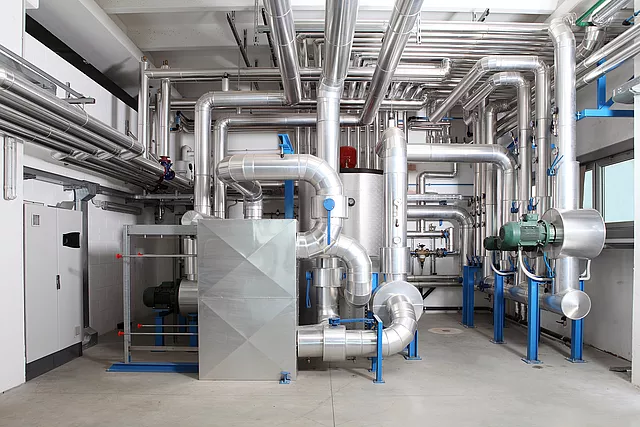
Unlock Maximum Energy Savings and Operational Flexibility
High-Efficiency, Low-Carbon Energy Solutions for Modern Industry
Industrial ice bank systems paired with high-performance heat pumps offer one of the most effective ways for manufacturers, processors, and commercial facilities to reduce energy costs, stabilize operations, and achieve ambitious sustainability goals. This innovative combination enables reliable process cooling, renewable heat generation, and long-term cost optimization – while significantly lowering CO₂ emissions. If you want to improve your facility’s energy efficiency or explore sustainable alternatives to fossil-fuel-based systems, request a free expert consultation to evaluate your potential savings.

Sven-Olaf Klüe
General Manager
Sven-Olaf Klüe has been working in the field of design, manufacture and applications of pillow plate heat exchangers worldwide for 27 years. For the past 15 years, he has focused specifically on the process-related applications of pillow plate heat exchangers in industrial applications.
How Ice Bank + Heat Pump Systems Deliver Real-World Value
Immediate Benefits for Industrial and Commercial Users
This technology directly addresses the core priorities of industrial decision-makers:
- Major energy savings: Ice banks store cooling energy at night – when electricity is cheaper – and supply cooling during peak daytime demand, cutting operating costs dramatically.
- Reduced CO₂ emissions: Heat pumps combine stored ice energy with renewable sources (ambient air, solar thermal, waste heat) to significantly reduce fossil fuel consumption.
- Operational security: Ice storage ensures cooling availability even during load spikes or extreme outdoor temperatures.
- High ROI: Optimized energy use, lower maintenance requirements, and reduced peak loads create attractive payback periods.
If your facility aims to improve energy efficiency, reduce peak electricity charges, or transition toward climate-neutral operations, our engineering team can create a tailored system design built around your actual load profile.
Our engineering team can create a tailored system design built around your actual load profile.
Why Forward-Thinking Facilities Choose Ice Storage with Heat Pumps
A Smarter Alternative to Conventional Cooling and Heating
Traditional heating and cooling systems rely heavily on real-time energy demand – making them costly, inflexible, and carbon-intensive. In contrast, ice bank heat pump systems:
- Shift energy consumption to low-tariff periods
- Integrate seamlessly with renewable energy sources
- Maintain stable operation in all weather conditions
- Support process cooling, building HVAC, and hot-water production from a single system
- Reduce reliance on fossil fuels and auxiliary electric heaters
Many manufacturing, food processing, logistics, and commercial operations use these systems to meet both production and sustainability requirements. To determine whether your facility could benefit, schedule a quick feasibility assessment with our specialists.
Maintain stable operation in all weather conditions and reduce reliance on fossil fuels and auxiliary electric heaters.
How the Technology Works
Intuitive Operation, Engineered for High Reliability
Industrial ice bank systems in combination with heat pumps consist of several integrated components designed for maximum efficiency and flexibility.
Ice Bank: The Core Thermal Battery
Water freezes inside a specialized storage tank. As ice forms, it releases latent heat at 93 Wh/kg (335 kJ/kg), which the heat pump captures and upgrades to useful heating.
Heat Pump: Efficient Renewable Heat Generation
A brine/water or air-to-water heat pump extracts energy from:
- The ice reservoir
- Ambient air
- Solar collectors
- Waste heat streams
- Ground-source regenerators
This upgraded heat can then be used for building heating, process heat, or hot-water generation.
Buffer and Storage Tanks: Load Management
Thermal buffers support peak demand, stabilize temperatures, and allow energy to be stored when it’s cheap – and used when it’s needed most.
Solar Collectors and Waste Heat Sources: Additional Efficiency Boost
Using solar thermal panels or industrial waste heat to regenerate the ice bank deepens energy savings and improves seasonal performance.
If you want to understand how these components would interact within your existing energy infrastructure, our engineers can develop a custom integration concept for your facility.
Thermal buffers support peak demand, stabilize temperatures, and allow energy to be used when it’s needed most.
Industrial Applications and Use Cases
Where Ice Bank Heat Pump Systems Deliver Maximum Impact
These systems are especially valuable in environments where energy use is intensive, predictable, and sensitive to cost fluctuations:
Process Industries
- Food & beverage processing
- Pharmaceutical and chemical cooling
- Plastics & molding
- Industrial refrigeration
Commercial & Public Facilities
- Shopping centers
- Hospitals
- Universities and municipal buildings
Sites With Limited Geothermal Potential
Ice storage provides a consistent heat source where ground-source heat pumps are impractical.
Want to learn how similar industries are deploying ice-bank technologies?
Ice Bank Heat Pump Systems are especially valuable in environments where energy use is intensive.
Ice Storage vs. Conventional Systems
Clear Advantages for Cost, Performance, and Sustainability
| Feature | Ice Bank + Heat Pump System | Conventional HVAC / Chillers |
| Energy Efficiency | Up to 50% reduction in consumption | Moderate to low; high load increases costs |
| CO₂ Emissions | Significantly lower due to renewable integration | High if fossil fuels are primary source |
| Operating Costs | Much lower – night tariffs + thermal storage | High due to peak-time energy use |
| Flexibility | Excellent – energy shift, peak shaving | Limited real-time operation |
| Maintenance | Low – simple, robust, long system life | Medium to high |
| Retrofit Suitability | Very good | Good |
If you want a cost-benefit analysis comparing your current system with an ice-bank-based approach, request a personalized ROI calculation.
Ice Bank and Heat Pump Systems are up to 50% reduction in consumption.
Key Decision Criteria for Industry Leaders
What Makes This Investment Attractive?
Organizations typically adopt ice-bank heat pump systems when:
- Energy prices are unpredictable or rising
- Sustainability and CO₂ reduction targets are a priority
- Process cooling and heating demands are growing
- Peak-load charges are affecting profitability
- Space or geological conditions limit alternative solutions
We can help you determine the financial and ecological advantage for your specific operating environment.
We can help you determine financial and ecological advantages.
Technical Overview (Engineer-Friendly Summary)
High-Value Technical Highlights, Optimized for Clarity
- Latent heat storage: Ice bank storage provides high energy density (93 Wh/kg).
- Heat pump integration: Operates efficiently even at low ambient temperatures.
- Thermal buffering: Reduces auxiliary heating and enables peak-load management.
- Renewable compatibility: Supports solar thermal collectors, waste heat recovery, and geothermal regeneration.
- Application versatility: Suitable for process cooling, space heating, and hot water.
- System performance: Energy savings up to 50% depending on load profile and operation strategy.
If you want a technical deep dive or system diagram for internal decision-making, we can prepare a tailored engineering package.
Take the Next Step Toward Smarter Industrial Energy Management
Industrial ice bank systems combined with high-efficiency heat pumps deliver the cost savings, operational flexibility, and sustainability performance that modern industry demands.
Energy savings up to 50% depending on load profile and operation strategy.
Frequently asked questions
Industrial Ice Bank Systems Combined with Heat Pumps
When properly engineered, these systems typically achieve 20–50% lower energy consumption compared to conventional chiller and boiler setups.
Savings come from:
- Shifting cooling production to low-tariff nighttime electricity
- Reducing or eliminating fossil-fuel-based heating
- Smoother load profiles that cut peak-demand charges
- High-efficiency heat pumps using renewable energy sources
Many industrial facilities see a 3–7 year ROI, depending on operating hours, tariffs, and system integration.
Ice banks store energy using latent heat, providing significantly higher storage density than water-based tanks.
Key advantages include:
- 93 Wh/kg thermal storage capacity (phase-change energy)
- Smaller footprint for equivalent capacity
- High discharge rates for peak-demand cooling
- Stable supply temperatures, even during outdoor temperature extremes
Conventional chillers must operate in real time, making them far less flexible and more expensive under peak load.
Yes – many facilities fully replace gas or oil boilers with heat pumps when ice storage and renewable heat sources are integrated.
A successful conversion requires:
- Correctly sized storage and heat pump capacity
- Reliable renewable or low-temperature heat sources (ambient air, solar thermal, waste heat, geothermal regeneration)
- Properly designed distribution systems
With the right engineering, the system can achieve 100% renewable heating and cooling, supporting corporate sustainability and CO₂ reduction goals.
Ice bank heat pump systems are suitable for both, and retrofits are very common.
Typical retrofit advantages include:
- Ability to integrate with existing chilled-water loops
- Modular ice banks placed indoors, outdoors, or underground
- Reduced mechanical room requirements compared to conventional systems
- Compatibility with existing HVAC and process cooling infrastructure
Most retrofits require only limited structural changes, making them attractive for older industrial facilities.
Ice storage provides a highly dependable thermal buffer, ensuring stable performance even when demand spikes or outdoor temperatures reach extreme highs or lows.
Reliability is improved by:
- Pre-charging the ice bank during low-load periods
- Operating heat pumps at optimal temperatures regardless of weather
- Maintaining cooling or heating even during utility grid fluctuations
This reliability is a major reason why food processing, pharmaceuticals, and other temperature-sensitive industries choose ice bank systems.
Maintenance requirements are generally low compared to traditional industrial refrigeration.
Typical tasks include:
- Periodic heat pump inspection
- Pump and valve checks
- Monitoring the ice bank’s freeze/thaw cycles
- Routine cleaning of heat exchangers and filtration systems
Because ice banks have no moving parts inside the tank, their lifespan is extremely long – often 25+ years with minimal maintenance.
To produce an accurate feasibility assessment or detailed system concept, engineers typically ask for:
- Current cooling and heating loads (hourly or monthly profiles)
- Operating hours and seasonal variations
- Existing HVAC/chiller/boiler system configuration
- Available installation space (indoor/outdoor)
- Electricity tariffs, including peak and off-peak pricing
- Interest in integrating renewable energy (solar, waste heat, etc.)
A preliminary evaluation can often be completed in 1–2 business days with basic load and tariff data.
Many industrial users experience short ROI periods thanks to substantial reductions in electricity costs, CO₂ levies, and peak-load charges.
For a precise ROI estimate, request a custom performance simulation based on your plant's energy profile.
We have always assimilated engineering science and thermodynamics optimally in the various manufacturing processes.
Thermodynamicists,mechanical engineers and welding engineers define the dimensioning, design and construction of customised heat exchanger panels and systems in materials ranging from mild and austenitic steels through to titanium, and ensure successful distribution of their work worldwide.
In doing so they fall back on production engineering expertise and calculations developed in the course of the past hundred years that are still being continuously optimised in an ongoing process.
In the perception of our customers, the Buco product stands for:
Technical and process-oriented consulting
Thermodynamic efficiency
Quality and longevity


